Sun TV Settles Shareholding Dispute: Maran Brothers Reach Truce Brokered by MK Stalin.

If you’ve tracked Indian media and politics for as long as I have, you’ll know one thing for sure: the biggest battles don’t always play out in courtrooms or boardrooms—they often unfold right at the family dining table. That’s exactly what we saw with the Maran brothers and their tug-of-war over Sun TV, a network that’s practically a household name in South India.
This wasn’t some small spat. We’re talking about a company worth thousands of crores, built over decades, suddenly at the center of a storm. Dayanidhi Maran, fiery as ever, accused his elder brother Kalanithi of quietly tightening his grip on Sun TV way back in 2003, and pocketing massive profits ever since. For a while, it looked like the clash would spill into full-blown legal warfare, dragging regulators, auditors, and courts into the mess.
And then—almost like the script flipped—M.K. Stalin, the Tamil Nadu Chief Minister and their uncle, stepped in. In one marathon family meeting, tempers cooled, the legal notice was withdrawn, and a fragile peace was stitched back together.
But here’s the thing: this isn’t just about family drama. It’s about how money, politics, and media power intersect in India—and why the Sun TV truce matters far beyond Chennai.
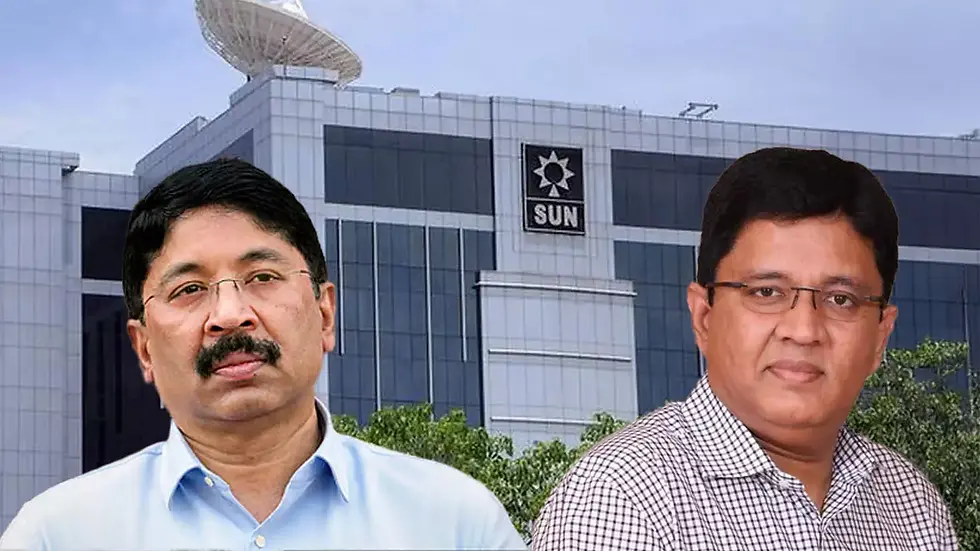
Who Are the Maran Brothers?
To understand the Sun TV dispute, you’ve got to first understand the men at the center of it: the Maran brothers.
On one side is Kalanithi Maran, often described as a media baron who spotted the future of satellite television before most people even had cable in their homes. Back in the early ’90s, when private TV was still a novelty in India, he launched Sun TV. Under his watch, it grew into a broadcasting empire—multiple channels, radio networks, newspapers, DTH services, even stakes in aviation at one point. If you’ve lived in Tamil Nadu, chances are Sun TV has been a part of your daily routine, whether through serials, movies, or prime-time debates.
Then there’s Dayanidhi Maran, the younger brother, who chose politics over the media boardroom. A long-time member of the DMK and once India’s Union IT Minister, Dayanidhi carved out his identity in New Delhi’s power corridors. But his political rise didn’t mean he lost sight of Sun TV. The family enterprise, after all, was always tightly woven into the DMK’s broader ecosystem of influence.
Both brothers are nephews of the late M. Karunanidhi, the iconic DMK patriarch. That family connection is what makes their clash so significant. It wasn’t just about shares and dividends—it was about legacy, control, and whose vision of the Maran name would dominate the future.
The Dispute Explained
Family feuds are nothing new in Indian business, but this one cut deep. To understand it, you’ve got to rewind to 2003—a year that Dayanidhi Maran hasn’t forgotten. Back then, Sun TV was already on the rise, a force in Tamil households. But according to Dayanidhi, that’s when his elder brother Kalanithi quietly pushed through a share allotment that shifted the balance of power. On paper, it might have looked routine. In reality, Dayanidhi says, it left him and the rest of the family with little say, while Kalanithi tightened his grip on the empire.
Fast forward two decades, and the numbers being thrown around are eye-watering. By Dayanidhi’s count, his brother has taken home ₹5,926 crore in dividends up to 2023, plus another ₹455 crore in 2024. In his legal notice, he didn’t mince words—he called it “fraudulent,” and demanded the ownership be reset to the pre-2003 structure, where the family and the Karunanidhi clan stood on equal footing.
For those of us who’ve watched Tamil Nadu’s media-politics ecosystem for years, this was explosive. A legal brawl between the Marans wouldn’t just embarrass the family—it would open Sun TV’s books to regulators like SEBI and the Enforcement Directorate. Imagine the headlines, the stock jitters, the endless scrutiny. Investors were already nervous, wondering if the fight would spill into the open market.
At its core, this wasn’t about two brothers disagreeing over money. It was about control of a media empire that shapes what millions see and hear every single day. And in Tamil Nadu, that kind of control isn’t just business—it’s raw political power.
The Dispute Explained
Family feuds are nothing new in Indian business, but this one cut deep. To understand it, you’ve got to rewind to 2003—a year that Dayanidhi Maran hasn’t forgotten. Back then, Sun TV was already on the rise, a force in Tamil households. But according to Dayanidhi, that’s when his elder brother Kalanithi quietly pushed through a share allotment that shifted the balance of power. On paper, it might have looked routine. In reality, Dayanidhi says, it left him and the rest of the family with little say, while Kalanithi tightened his grip on the empire.
Fast forward two decades, and the numbers being thrown around are eye-watering. By Dayanidhi’s count, his brother has taken home ₹5,926 crore in dividends up to 2023, plus another ₹455 crore in 2024. In his legal notice, he didn’t mince words—he called it “fraudulent,” and demanded the ownership be reset to the pre-2003 structure, where the family and the Karunanidhi clan stood on equal footing.
For those of us who’ve watched Tamil Nadu’s media-politics ecosystem for years, this was explosive. A legal brawl between the Marans wouldn’t just embarrass the family—it would open Sun TV’s books to regulators like SEBI and the Enforcement Directorate. Imagine the headlines, the stock jitters, the endless scrutiny. Investors were already nervous, wondering if the fight would spill into the open market.
At its core, this wasn’t about two brothers disagreeing over money. It was about control of a media empire that shapes what millions see and hear every single day. And in Tamil Nadu, that kind of control isn’t just business—it’s raw political power.
The Role of MK Stalin
Every Tamil family has that one elder who steps in when the younger ones are at each other’s throats. In the Maran family, that role fell to none other than M.K. Stalin, Tamil Nadu’s Chief Minister and DMK president. But this wasn’t just a family squabble over dinner—it was a high-stakes clash that risked spilling into courtrooms and stock markets. For Stalin, the fallout wasn’t just personal, it was political.
The DMK prides itself on projecting unity. A messy, public fight between two of its most visible family members—both nephews of the late party patriarch M. Karunanidhi—would have been a gift to the opposition. The last thing Stalin needed was headlines about the DMK’s “first family” tearing itself apart while Sun TV, the network long seen as the party’s media megaphone, came under unwanted scrutiny.
So Stalin did what seasoned politicians do best: he brokered peace. Reports suggest he brought both brothers together for a closed-door meeting. His son Udhayanidhi Stalin, a minister in his cabinet, and the brothers’ sister Anbukarasi were also part of the talks. It was classic DMK style—keep the fight within the family, keep the public face polished.
By the end of that meeting, Dayanidhi had agreed to withdraw his legal notice, effectively cooling the fire before it became a blaze. There were no courtroom battles, no messy regulatory probes, no stock free-fall. Just a carefully stitched truce.
But let’s be clear: this wasn’t only an act of family loyalty. For Stalin, stepping in was also about protecting the DMK’s image, keeping the party machinery intact, and making sure the Maran brothers didn’t take the fight beyond the walls of Gopalapuram.
Resolution – The Truce
In the end, the Sun TV storm didn’t end with a judge’s gavel or a regulator’s raid. It ended in a living room, with the family huddled together under the watch of M.K. Stalin. After hours of talks, the message was clear: this feud could not be allowed to go public.
Dayanidhi, who had come out swinging with a legal notice, agreed to withdraw it. Kalanithi, for his part, kept a low profile, letting the silence signal victory without rubbing it in. The official word was simple: the brothers had “resolved their differences” after discussions with their uncle. No long statements, no grand gestures—just a quiet end to what could have been a very noisy battle.
For investors, the truce brought relief. For the DMK, it was damage control at its finest. And for the Maran family, it was a reminder that no matter how bitter things get, politics and legacy demand unity, at least in public view.
Whether this peace holds is another story. For now, though, the legal guns have been holstered, and the Sun TV empire continues to shine as if nothing ever happened.
Implications for Sun TV
For a company like Sun TV, stability is everything. Audiences may still tune in for their favorite serials and movie premieres, but behind the screen, investors and advertisers are watching just as closely. A family feud of this scale could have rattled both.
The immediate relief is obvious: with the dispute dialed back, Sun TV avoids the kind of messy courtroom drama that could have dragged its financials and reputation through the mud. Regulators like SEBI or the SFIO poking around would have spooked shareholders, triggered endless headlines, and raised questions about governance in one of India’s most profitable broadcasters. By pulling back, Dayanidhi effectively saved the company from a crisis of confidence.
But here’s the uncomfortable truth: the truce doesn’t erase the core issue—it only buries it. Questions about ownership, dividends, and how much influence one brother has over the other haven’t magically disappeared. For now, the family has chosen unity over confrontation, but markets hate uncertainty. And uncertainty is exactly what lurks beneath the surface.
That said, Sun TV’s dominance in South India gives it a cushion most companies would envy. Viewership is strong, advertising revenue remains steady, and culturally, the network is too entrenched to collapse overnight. If the brothers can keep their peace, Sun TV may well continue shining without interruption. But if old wounds resurface, the cracks could quickly become visible again—this time in front of regulators, investors, and millions of viewers.
Implications for Sun TV
For a company like Sun TV, stability is everything. Audiences may still tune in for their favorite serials and movie premieres, but behind the screen, investors and advertisers are watching just as closely. A family feud of this scale could have rattled both.
The immediate relief is obvious: with the dispute dialed back, Sun TV avoids the kind of messy courtroom drama that could have dragged its financials and reputation through the mud. Regulators like SEBI or the SFIO poking around would have spooked shareholders, triggered endless headlines, and raised questions about governance in one of India’s most profitable broadcasters. By pulling back, Dayanidhi effectively saved the company from a crisis of confidence.
But here’s the uncomfortable truth: the truce doesn’t erase the core issue—it only buries it. Questions about ownership, dividends, and how much influence one brother has over the other haven’t magically disappeared. For now, the family has chosen unity over confrontation, but markets hate uncertainty. And uncertainty is exactly what lurks beneath the surface.
That said, Sun TV’s dominance in South India gives it a cushion most companies would envy. Viewership is strong, advertising revenue remains steady, and culturally, the network is too entrenched to collapse overnight. If the brothers can keep their peace, Sun TV may well continue shining without interruption. But if old wounds resurface, the cracks could quickly become visible again—this time in front of regulators, investors, and millions of viewers.
Conclusion
When you peel back the layers of the Sun TV dispute, it’s clear this was never just a fight about shares on a balance sheet. It was about legacy, money, and the kind of power only a media empire can deliver in a state like Tamil Nadu.
For a moment, it looked like the Maran brothers were ready to drag each other through the courts, pulling Sun TV’s reputation and investor confidence down with them. But the old rule of politics and family prevailed: don’t let the cracks show in public. M.K. Stalin’s
intervention stitched the wound quickly, not just for the sake of his nephews, but for the stability of the DMK and the empire it leans on.
Does that mean the story’s over? Probably not. Family feuds have a way of resurfacing, especially when the money involved runs into thousands of crores. But for now, at least, the Marans are back on the same side, Sun TV’s screen continues to glow, and the DMK can breathe a sigh of relief.
In India, where business and politics are often one and the same, this saga was a reminder: the real battles aren’t always fought in Parliament or boardrooms. Sometimes, they’re settled around the family table. 🚀 Ready to take your leadership journey to the next level?
Join a network of visionary professionals shaping the future of corporate governance.
🔗 Reserve your spot for our next live webinar and discover how you can make your mark at the board level.
🌐 Explore more at BoardSearch


Comments